












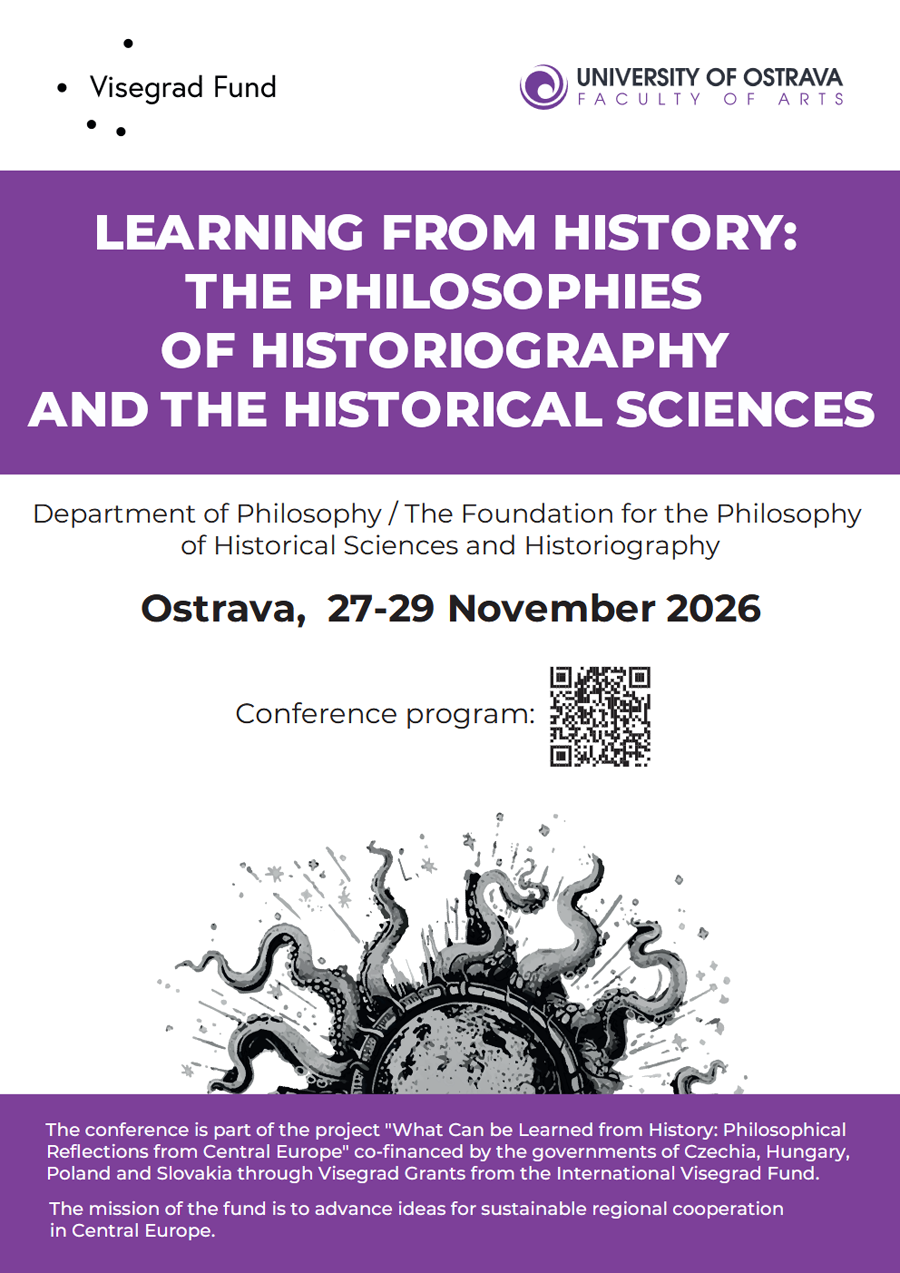
Conference Learning from History: The Philosophies of Historiography and the Historical Sciences (November 2026)
Call for Registration
Registration is now open for the conference Learning from History: The Philosophies of Historiography and the Historical Sciences, which will take place at the University of Ostrava from November 27-29. If you would like to attend, please register by November 1 by emailing with "Conference Registration" in the subject line.
Conference Programme  0,35 MB
Book of Abstracts 0,37 MB
Call for Papers:
Learning from History: The Philosophies of Historiography and the Historical Sciences
The University of Ostrava, Czech Republic, 27-29 November 2026
Confirmed keynote speakers (alphabetically):
- Carol Cleland
- Adrian Currie
- Michal Hubálek
- Jouni-Matti Kuukkanen
- James McAllister
- Gregory Radick
- Franziska Reinhard
- Adam Timmins
- Aviezer Tucker
- Peter Turchin
- Derek Turner
The philosophy of history, the ontology of the past, and the philosophy of historiography, the epistemology of knowledge of history, are rapidly expanding philosophical fields. This expansion is partly driven by the progress of the historical sciences in broadening the scope of our knowledge of history by discovering new evidence and new information theories that allow decoding it and inferring knowledge of the past. These developments call for new philosophies of the historical sciences and historiography that encompass the new ontologies and epistemologies of all the historical sciences that can make warranted inferences about history.
The philosophy of the historical sciences is distinct of other sub-fields of epistemology and the philosophy of science in studying the generation of knowledge of the past, of history, which depends on signals that cross the entropic barrier of time. This conference will consider the philosophical, ontological and epistemic implications of the new historical sciences and historiography that form the foundation for learning from the past. This conference will attempt to found a new sub-field of the philosophy of science, devoted to the philosophy of the historical sciences.
The conference will take place at the Foundation for the Philosophy of Historical Sciences and Historiography at the University of Ostrava in the Czech Republic, with support from the Visegrad Fund and the University of Ostrava, and in cooperation with the University of Silesia in Katowice in Poland, and the Catholic University in Ružomberok in Slovakia.
We call for abstracts of 250-500 words in the philosophy of historiography and the historical sciences to be submitted by the 31st of August 2026. There will not be a conference fee, but registration is required. Please send abstracts, queries, and correspondence to: .
The Foundation for the Philosophy of Historical Sciences and Historiography is comprised of five researchers and has existed for three years with generous support from the European Union, the Czech Grant Agency, and the Visegrad Fund. It holds regular in person and remote seminars. Next year, in August 2027, it will co-convene a summer school in the philosophy of historiography and the historical sciences with emphasis on the philosophical foundations of applied history at the Catholic University of Ružomberok in Slovakia.
Ostrava, in the North-East corner of the Czech Republic, is the second largest urban conglomeration in the country after Prague. It has an airport with regular flights from Warsaw, Malaga, and London-Stansted. It can also be reached by bus from the airports of Katowice and Krakow in Poland, and by train from Vienna and Prague. By train, Ostrava is about 2.5 hours from Krakow, 3 hours from Vienna, and 3.5 hours from Prague.
The conference is part of the project "What Can be Learned from History: Philosophical Reflections from Central Europe" co-financed by the governments of Czechia, Hungary, Poland and Slovakia through Visegrad Grants from the International Visegrad Fund. The mission of the fund is to advance ideas for sustainable regional cooperation in Central Europe.

Post-conference social programme
We are pleased to offer conference participants three optional excursions following the official end of the conference. These trips provide an opportunity to explore the rich historical, cultural, and industrial heritage of the Ostrava region. Participants may choose between a visit to the former Vítkovice steelworks in Ostrava, an architectural walk through the district of Poruba, or an excursion to the historic city of Olomouc. Further details regarding meeting points and timing will be provided during the conference.
Visit to the Vítkovice Steelworks
Located within walking distance from Ostrava′s city centre, the former Vítkovice Steelworks offers the opportunity to explore one of Europe′s most remarkable industrial heritage sites. Once the heart of heavy industry in the Czech lands, the vast complex preserves blast furnaces, coking facilities, and mining infrastructure that powered regional industrial development for more than a century. Today, the area known as Dolní Vítkovice has been transformed into a cultural and educational landmark, where visitors can experience the (ginormous) material remains of industrial modernity.
The excursion offers panoramic views from the former blast furnace complex as well as an opportunity to experience one of Central Europe′s most successful industrial heritage projects, all within easy reach of the conference venue and accommodation.
Visit to Poruba
The excursion to Poruba, one of Ostrava′s most distinctive districts, will introduce participants to the urban and architectural history of post-WWII Central Europe. Developed primarily after the Second World War, Poruba was conceived as a socialist model district, combining monumental socialist-realist architecture with modernist planning. Its grand boulevards, arcaded streets, and carefully designed public spaces provide a fascinating window into changing visions of urban life, political authority, and social organization.
Today, Poruba is not only one of the city′s most attractive residential areas but also a living historical landscape in which different layers of recent history remain visible. A guided walk through its central avenues and public spaces will reveal the complex relationship between ideology, architecture, and everyday life in post-war Central Europe.
Excursion to Olomouc
The excursion to Olomouc, one of the Czech Republic′s most beautiful historic cities, offers participants the opportunity to explore the former Moravian capital whose rich past is reflected in its architecture, monuments, and academic institutions. With a history stretching back to the Middle Ages, Olomouc was long a major political, religious, and cultural centre of Central Europe. Visitors will encounter a remarkably preserved historic core, including the UNESCO-listed Holy Trinity Column, the Archdiocesan Cathedral of St. Wenceslas, and numerous examples of Gothic, Renaissance, and Baroque architecture. Olomouc is also home to Palacký University, the second-oldest university in the Czech lands. The excursion will be guided by Aviezer Tucker, who lived in Olomouc for several years during the 1990s.
Updated: 18. 11. 2026


